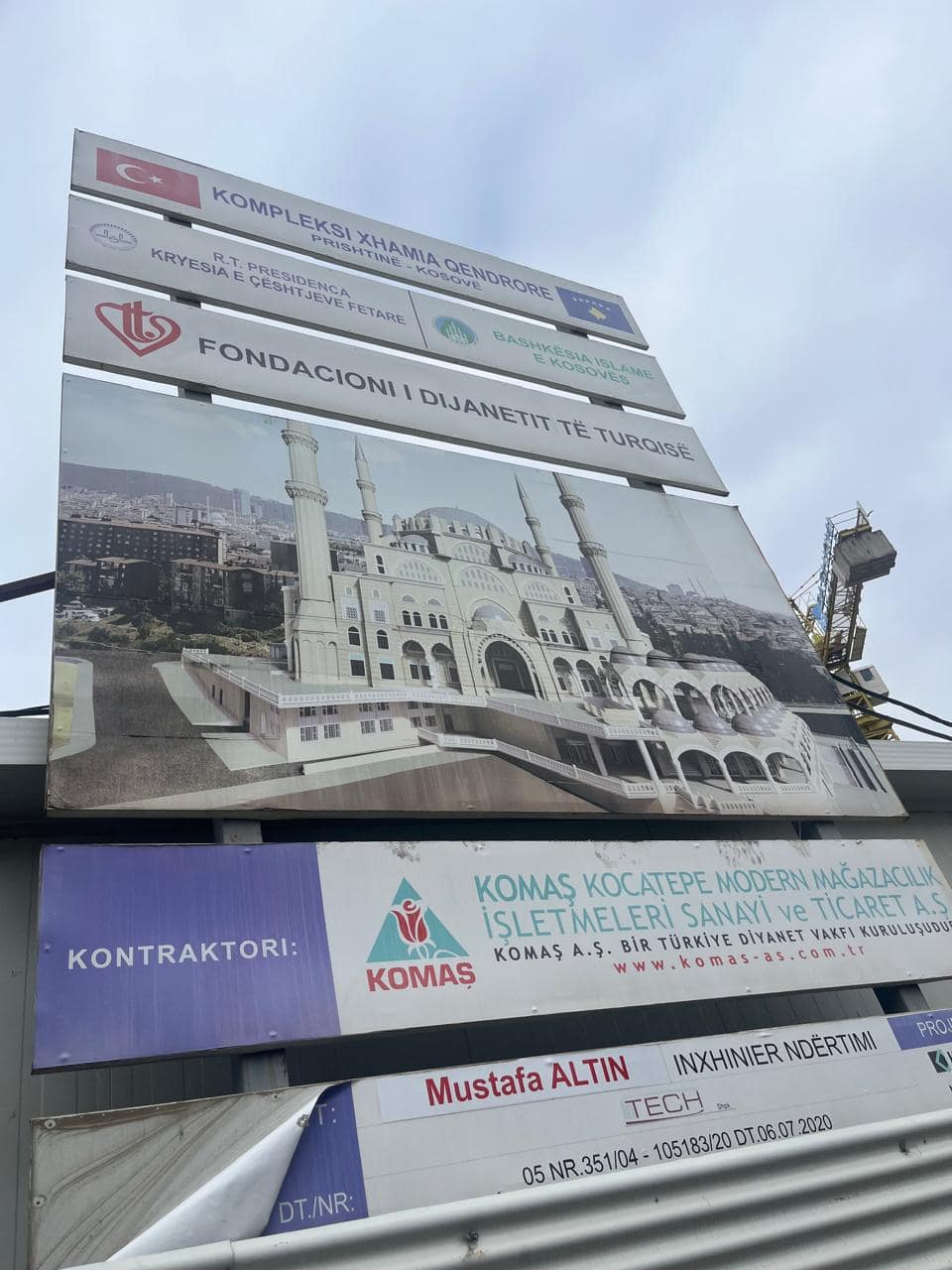
We stood staring at the information board for the new mosque complex in Pristina, one of the sites we visited on our recent InfraEmpire fieldtrip to the Balkans (see figure 1).
At first glance, the geopolitics of the site are plain to see. The board shows the Turkish flag alongside that of Kosovo, the emblem of the Turkish Presidency of Religious Affairs (Diyanet), as well as the name of the Turkish contractor and head engineer. It is, we are told, a gift from Turkey, funded and built by the Diyanet in collaboration with the Islamic Union of Kosovo (BIK).
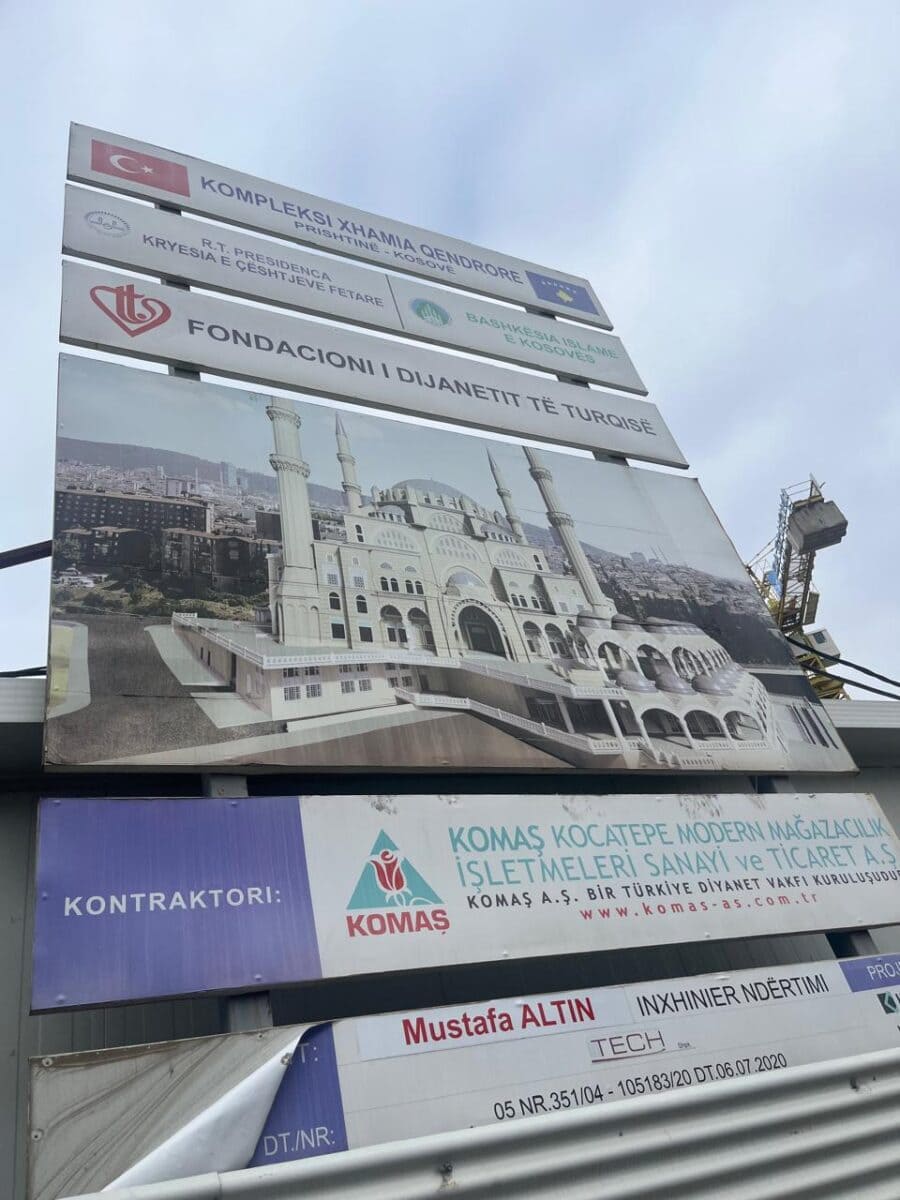
A three-dimensional computer-generated render provides a flawless image of the future mosque: a huge structure flanked by four minarets (a feature, incidentally, once strictly reserved for Ottoman emperors), a standard template modelled on the Selimiye Mosque in Edirne.
Yet, as my eyes moved from the billboard to the building site that lay before us, I was struck by a disconnect: between the polished render and the chaotic scene of cranes soaring overhead and the tops of rebar cages poking out over corrugated iron fencing.
I took a step back and attempted to picture how the mosque might sit in the city’s skyline. But something was off. At this point, one of our local participants leant over my shoulder and pointed out a second disconnect: the background in the render was not Pristina at all, but somewhere in Turkey.
These disconnects tell us something important about a friction inherent in these infrastructural sites.
On the one hand, we have a standardised ‘Turkish’ template. As one of the trip’s participants, Dr. Kerem Öktem, explains, these should be seen as nodes in a regional network of Turkish infrastructural influence. Similar “New Imperial” mosques have sprung up all over Turkey in recent years in airports, parks and university campuses. Another has been built in Tirana, in neighbouring Albania.
On the other hand, these nodes materialise in existing local urban fabrics. It is at these points of friction between the standardised network node and highly specific, highly localised contexts that the sites become geopolitically charged.
This geopolitical charge may emerge in different ways and in different places. Shortly after the ceremonial cornerstone of the mosque was laid in 2012, it was graffitied with anti-Turkish sentiment.
When myriad design proposals were overlooked, including one by Zaha Hadid Architects, some local commentators complained of an Ottoman “copy-paste job” conjuring imaginaries of Kosovo’s Ottoman past and its present and future links with Turkey (see here).
Today the mosque may be experienced more through the dust, noise and disruption that come with any huge construction project.
Once completed, the mosque will take on yet another life as a külliye: a multifunctional complex housing shops, restaurants, cafés and a massive underground car park.
As projects move through their various life phases – from announcement, to plan, to building site, to finished product (if they make it that far) – the visibility of this geopolitical charge may appear to wax and wane, as overt political graffiti and public debate give way to more mundane experiences.
But a decline in public debate or open critique does not necessarily mean that the geopolitical charge of an infrastructure project has disappeared. Rather, it may seep into the everyday worlds that form around it.
I have observed a similar dynamic in my own fieldsite in Tashkent. Amidst a surge of Chinese infrastructural investment, it was not so much the Chinese-built projects themselves that sparked anxiety of a ‘Chinese take-over’ amongst my interlocutors. It was the infrastructural worlds that emerged around them: the influx of labour migrants that accompanied them; the sudden appearance of new restaurants, shops and schools to service this new population; and even a small sporting event in a public park.
Of course, the entanglement of large infrastructural projects with the everyday worlds around them is nothing new. As another colleague, Professor Isa Blumi, explained, the emergence of everyday commercial and social worlds around road and rail networks was equally common in the Ottoman Balkans and these often acted as sites of resistance.
The question, then, is how we might attend ethnographically to the geopolitical charge of these sites, as it emerges at the meeting point between standardised network and specific locale. This may mean studying infrastructural projects across their lifespans, from concept to completion, and paying careful attention to how and where these charges emerge in everyday life: from graffiti and debates over design, to rumours and speculation, to dust, cranes, cafés and restaurants. This may in turn help us to understand how the geopolitical ambitions of regional powers like Turkey are materialised in infrastructural projects in specific places, and ultimately how they are lived, interpreted and contested in the everyday.