In places as far-flung as Addis Ababa and Astana, Dakar and Dushanbe, high-speed railways and shiny new city centres promise to boost economies and give a better life, as well as to boost a nation’s position in geopolitical hierarchies. Yet, in large parts of the world it is not one’s own state but rising economic powers with global ambitions such as China and Turkey who fund and build these new futures. These global ‘big brothers’ employ infrastructural largesse to showcase their own generosity and greatness, as well as to drive construction in their own capitals and to create ‘soft power’ empires.
INFRAEMPIRE offers the idea of infrastructural imperialism to understand the contested ways in which such global big brothers, in reconstructing much of the world, are also constructing new forms of power. INFRAEMPIRE takes Turkey as a paradigmatic case to investigate the type of power that is emerging in a new, multipolar world. Much research on foreign infrastructural investment has focused on China, an economic giant whose Belt and Road Initiative is connecting and transforming large swathes of the globe. Turkey is a regional power, one that does not have China’s economic heft but has similar ambitions. Over more than two decades, the Turkish government has made the construction sector one of the motors of the country’s economy and one of the main ways in which Turkey wields influence around the world. Indeed, the country’s investment in foreign infrastructure far exceeds its size. Moreover, despite their differences, the two countries share a vision of multipolarity that rejects Western democratic ideals in favour of national ‘greatness.’ INFRAEMPIREargues, then, that we can more clearly understand the growing strength of authoritarianism and illiberal capitalism around the world by looking at the spectacular projects that authoritarians use to symbolize their strength and the speculation that swirls around them.
INFRAEMPIRE claims that investing in other states’ infrastructure is about more than just influence; it is also about new imaginations of the geopolitical future. This is a future in which the global balance of power has shifted, and the West is no longer the peak of progress. Indeed, these visions of multipolarity are also about an imagined return to a period of empires, whether a new form of empire or the revival of a form that predates the European colonial era. Certainly, it is not unimportant that rising powers such as China and Turkey capitalise on having remained uncolonised by Western European powers and on being the seats of historical empires whose glory they often reference.
Often building on these historical connections, the Turkish government, like China, India, and similar rising powers, offers economic and material development to client states without explicit political pressures. The aim appears to be cultivating what one Somalian Finance Ministry spokesperson called ‘the Somali people’s feelings of respect and gratitude towards Turkey’ as a result of that country’s investments. Or as one Senegalese minister remarked regarding China, ‘Beyond just money, China is seen by many Africans as a model to aspire towards.’ As a form of soft power, then, infrastructure is one of the primary ways to assert ‘greatness’ and the capacity for a ‘modern’ future even without conforming to prescriptive formulae for democracy, security, and economic growth.
Moreover, infrastructure instantiates the aspirations that patron and client states share: when China signs a contract to build a spectacular new port in a fishing village in Tanzania or Turkey bargains to build a futuristic city in the Senegalese desert, all countries involved are acknowledging common ideals or goals. These ideals are often framed in a language of national uniqueness and rejection of copying ‘the West’ that they demonstrate in the ‘greatness’ of megaprojects, which materialise visions of non-Western futures.
INFRAEMPIRE will explore how such projects change people’s lives, materialise new global imaginaries, and become the scaffolding for new forms of power around the world.
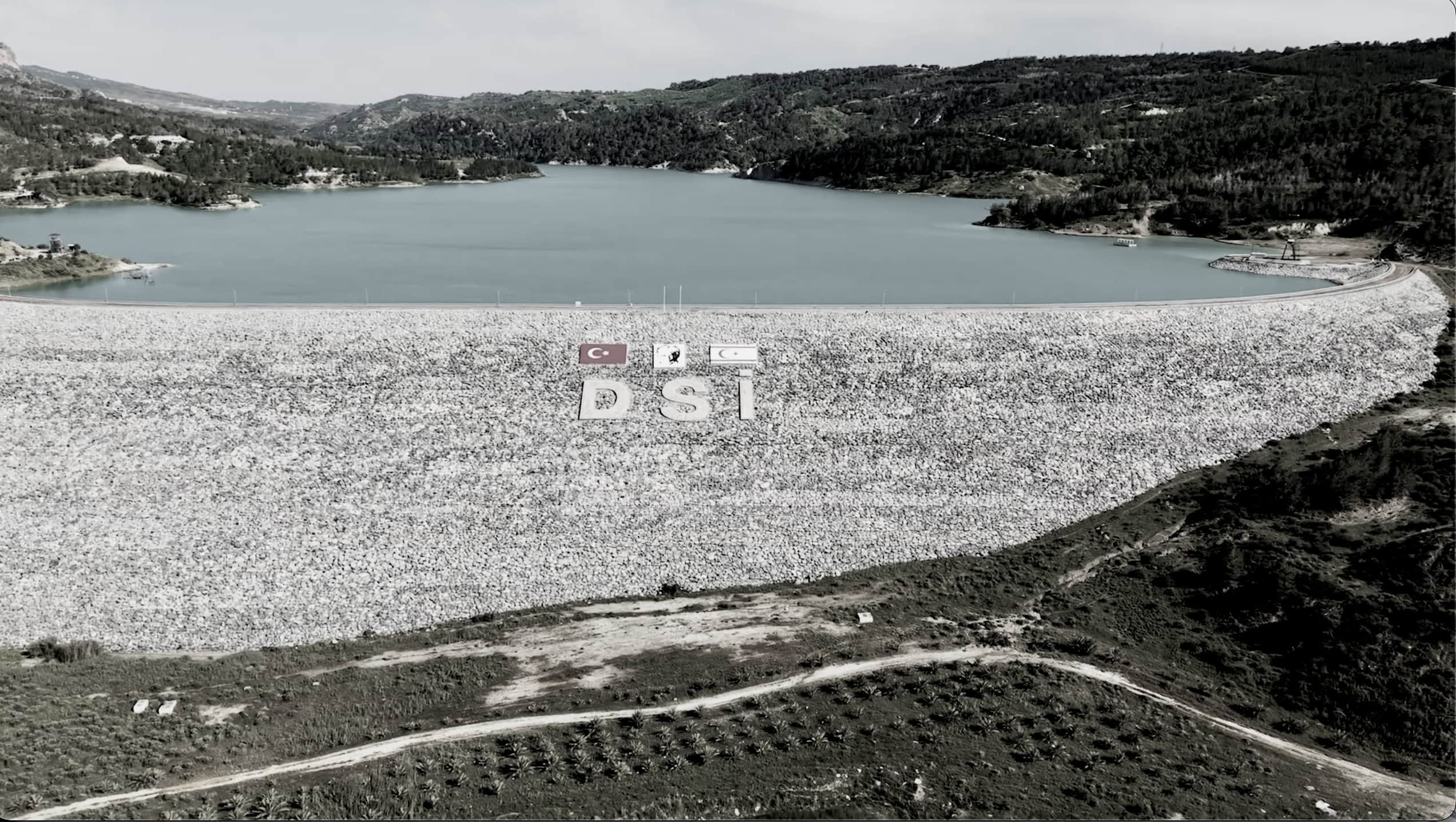
Geçitköy Dam, north Cyprus
In 2015, the Turkish government completed a project to build an experimental undersea pipeline delivering fresh water from the Taurus Mountains of southern Anatolia across 60 kilometers of sea to north Cyprus. The water is held in the Geçitköy Dam. Part of it is purified for household use and part is used directly for crops. Video ©Doğuş Bozkurt, photo ©Rebecca Bryant