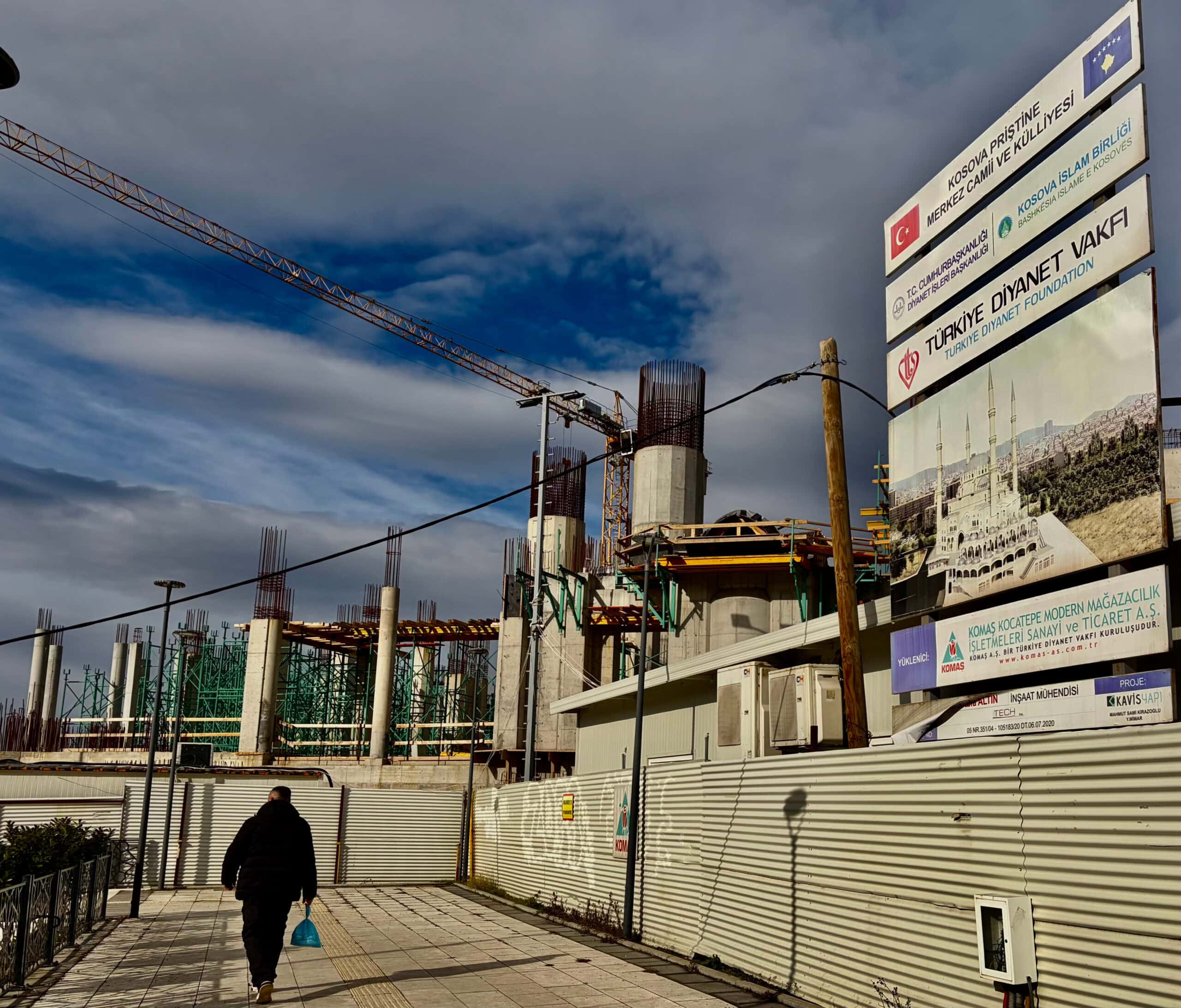



In 2015, Turkish president Erdoğan traveled to north Cyprus to inaugurate an undersea freshwater delivery pipeline that he labeled “the project of the century.” The project relied on technology that had not been used elsewhere in the world to deliver water across 60 kilometers of sea from the peaks of the Taurus Mountains to the desertifying island. It did appear to have claims to the “project of the century” label. However, it did not have exclusive claim. Indeed, members of the ruling Justice and Development Party quickly picked up the label and began applying it to various megaprojects, from the renewal of water and sewage pipelines in Yozgat to the mass building of housing in the aftermath of the 2023 earthquake—the latter labeled “the construction of the century.”
The Turkish government, however, is not the first or only to use this label. In the 1970’s, it was the label given to a Soviet nuclear reactor project developed in Cuba. In the Philippines, the government has given the label to Manila’s new subway project. And perhaps most significantly today, it is also the label that Chinese President Xi Jinping has given to that country’s globe-spanning Belt and Road Initiative.
This workshop asks what this epochal temporality, which gestures to the past while pointing towards the future, tells us about the relationship between infrastructures and empire. In this epochal vision, the size and scope of the project appears an intrinsic part of a megaproject’s meaning and justification. If “ordinary” infrastructures, such as roads and water pipelines, show us what Michael Taussig (1992: 113) calls the “powerful insubstantiality” of the state, megaprojects such as futuristic cities, pipelines, and canals that challenge nature all call attention to the state in their spectacularity. Even more than this, such “projects of the century” are daring, risky, even “crazy”—as Erdoğan has called his project to build a new canal to the west of Istanbul. Such a description, in turn, evokes the exploits of legendary leaders, such as Mehmet II’s audacious conquest of Istanbul, even while indicating that future conquests will be material and economic.
Infrastructure, then, recalls a past imperial order even as it becomes a site for staging new geopolitical futures and acting out narratives of a new multipolarity.
The workshop invites colleagues working on historical and contemporary infrastructural projects at the intersection of Russian, Chinese, and Turkish influence to collectively ponder the role of epochal temporalities in the power–infrastructure nexus. Turkey and China, in particular, have emerged as centers of influence, radiating towards neighboring regions formerly under imperial control as well as distant territories through infrastructural projects. However, infrastructures remain even when influence fades, and so we wish also to examine the palimpests of materiality and power at the seam of Eurasia, where these spheres of influence meet. The workshop aims to explore how past imperial experiences and spaces are re-imagined through contemporary projects while interrogating the coexistence of multiple imperial legacies as they are rearticulated in the present.